

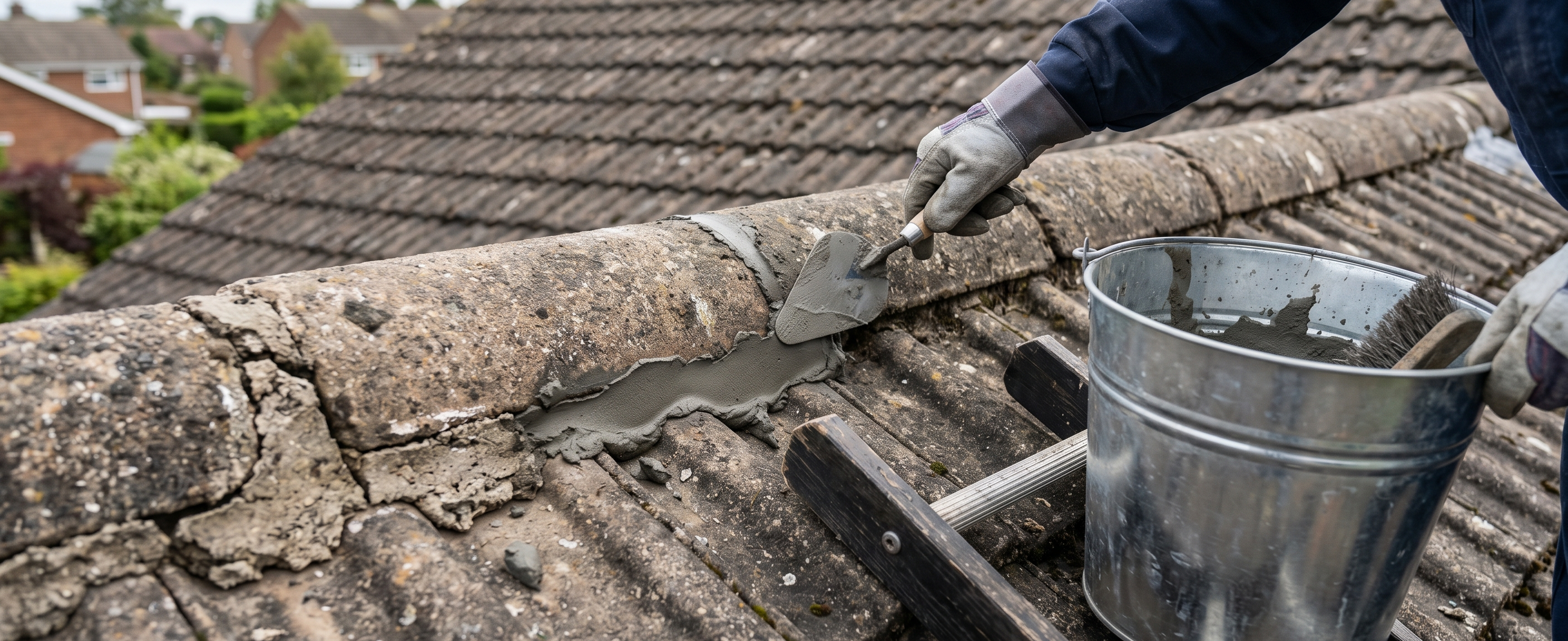
You are about to paint your roof. You have cleaned the tiles, treated the moss, and bought the sealer. But before you open that paint tin, look at the Ridges (the V-shaped tiles at the apex) and the Verges (the mortar edge at the gable end). Are they cracked? Are chunks of cement missing? If you poke a ridge tile, does it wobble?
Painting over loose mortar is like painting over rust on a car. It looks good for a month, and then a chunk falls off, taking your new paint with it. The coating is cosmetic; the mortar is structural. You must fix the structure first. Here is how to repair the cement work so it lasts as long as your new paint job.
The Inspection
Don't just look from the ground. You need to get close (safely).
-
The Ridges: Gently try to lift or wiggle the ridge tiles. If they move, the mortar bond is broken. You cannot just point over the cracks; the tile needs re-bedding.
-
The Verges: Look for "hairline cracks" running through the cement. Water gets in these cracks, freezes, and pops the face off the mortar.
The Golden Rule
The biggest mistake DIYers make is spreading a thin layer of fresh cement over old, dirty cement (buttering over). This will fail. New mortar does not stick to old, dusty mortar. It will shell off in the first frost.
-
Dig it out: If the pointing is loose, chisel it out completely. You need a gap of at least 20–30mm depth to get a good key for the new mortar.
-
Remove debris: Brush out all the dust and loose sandy particles.
Choosing Your Material
You have two choices for the repair material.
Option A: Traditional Sand & Cement (The Cheap Way)
This is the standard way, but it requires mixing skills.
-
The Mix: Use a 3:1 ratio (3 parts Sharp Sand to 1 part Cement).
-
Tip: Do not use Soft/Building sand alone; it is too weak for roofs. Sharp sand gives strength.
-
Additives: You must add a liquid plasticiser or a waterproofing agent (like SBR). This makes the mix flexible and sticky, stopping it from cracking in the sun.
-
Colour: You can add black dye (Cement Tone) to match an old roof, but if you are painting the whole roof afterwards, natural grey is fine.
Option B: Roof Putty / Flexim (The Easy Way)
This is a modern, lightweight alternative to mortar. It comes in pre-mixed vacuum-packed bars.
-
Pros: It stays permanently flexible. It doesn't crack. It is instantly waterproof and extremely sticky.
-
Cons: It is more expensive than a bag of sand.
-
Best For: Re-bedding loose ridge tiles without having to mix muck on top of a ladder.
The Technique
-
Wet the Surface: Before applying cement, wet the old tile and the old mortar with water (or SBR bonding agent). Dry tiles suck the moisture out of wet cement, killing the bond.
-
Pack it Tight: Press the mortar firmly into the gap with a pointing trowel. Eliminate air pockets.
-
Strike it Smooth: Use the edge of the trowel to slice off the excess. Do not leave "snots" of cement on the face of the tile - they will show through the paint.
-
Weep Holes: If you are pointing a ridge, ensure you don't block the natural ventilation gaps entirely (unless using a breathable ridge system).
Painting Over Repairs
If you use traditional sand and cement, you must be careful when painting. Fresh cement is highly Alkaline.
-
The Risk: If you put paint on wet or "green" cement, the alkali will burn the paint resin, causing it to flake or turn white (Saponification).
-
The Wait: Ideally, let the mortar cure for 28 days.
-
The Hack: If you can't wait that long, prime the repair with an Alkali-Resistant Primer or ensure your roof coating is breathable and alkali-stable.
Note: Roof Putty can usually be painted over after 24-48 hours (check the label), making it faster for coating projects.
Conclusion
One of the biggest benefits of painting your roof is that it hides these repairs. Once you coat the tiles and the mortar in the same "Charcoal Grey" or "Terracotta," the repairs become invisible. The roof looks like a single, seamless unit.
-
Chisel out loose muck
-
Use Sharp Sand (3:1)
-
Wait for it to cure before painting
Share:
Removing Moss and Lichen: Why You Should Never Pressure Wash Old Tiles
Restoring Delaminated Slate: Should You Clean or Replace?